
NFF Sets Up Fact-Finding Committee After Super Falcons’ Historic World Cup Miss
By Cynthia Okere
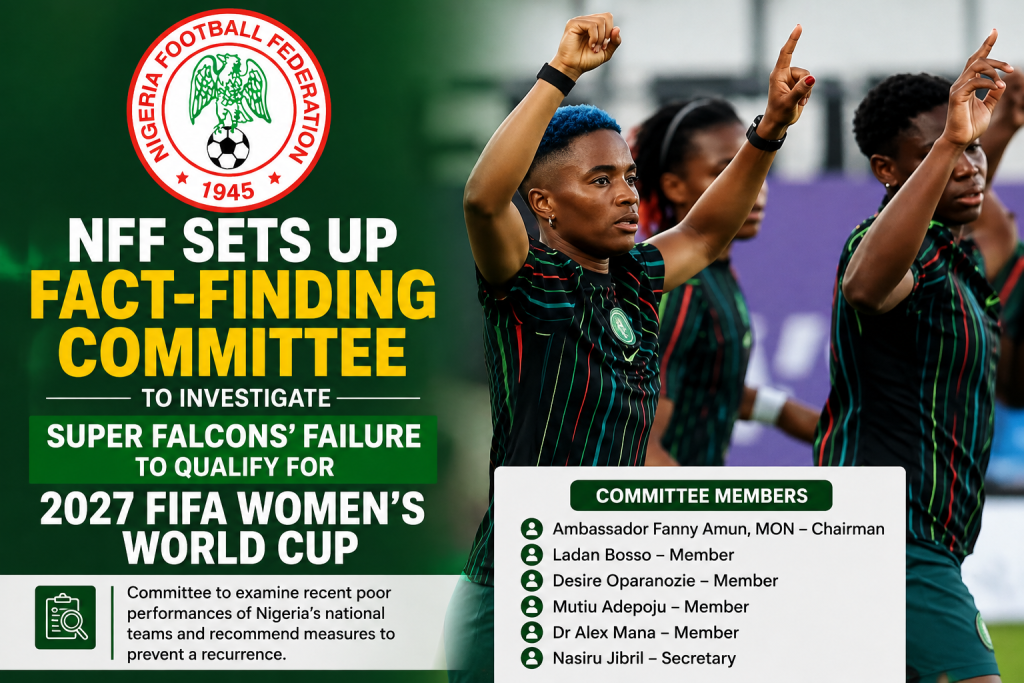
The Nigeria Football Federation (NFF) has constituted a fact-finding committee to investigate the recent poor performances of the country’s national teams, with particular attention on the Super Falcons’ failure to qualify for the 2027 FIFA Women’s World Cup.
The move comes after a disastrous Women’s Africa Cup of Nations campaign in Morocco which saw Nigeria fail to reach the semi-finals before losing another opportunity to remain in contention for a World Cup place.
The Super Falcons, who entered the competition as defending African champions, were eliminated by Cameroon in the quarter-finals. That defeat denied them one of the automatic World Cup qualification places available at the tournament.
Nigeria were subsequently handed another opportunity through a playoff against South Africa, but Banyana Banyana won the encounter 2-1 on August 13, ending the Super Falcons’ hopes of reaching the 2027 tournament in Brazil.
The result carries particular significance because Nigeria had participated in every edition of the FIFA Women’s World Cup since the competition began in 1991.
That uninterrupted record will now end in 2027.
NFF Orders Investigation
Following the setback, the NFF announced that the newly constituted committee would examine the circumstances behind the recent failures involving Nigeria’s national teams and recommend measures aimed at preventing a recurrence.
According to the federation, the exercise is intended to identify factors responsible for the poor performances and provide recommendations capable of improving the fortunes of the national teams.
Former Nigeria coach and football administrator Ambassador Fanny Amun, MON, has been appointed chairman of the committee.
Other members are former Super Eagles coach Ladan Bosso; former Super Falcons captain Desire Oparanozie; former Super Eagles midfielder Mutiu Adepoju; and Dr Alex Mana.
Nasiru Jibril will serve as secretary.
The inclusion of former internationals and coaches gives the committee considerable football experience, but attention will ultimately turn to the scope of its investigation and whether its recommendations will result in measurable changes.
Questions Go Beyond the Super Falcons
Although the Super Falcons’ World Cup failure triggered the latest response, the NFF says the committee will look more broadly at setbacks involving Nigeria’s national teams.
That distinction is important.
The investigation therefore presents an opportunity to examine not only what happened on the pitch in Morocco but also the structures surrounding preparation, technical management, player development, welfare, administration and long-term planning.
Before the WAFCON tournament, the NFF Executive Committee had specifically challenged the Super Falcons to achieve two major objectives: qualify for the 2027 FIFA Women’s World Cup in Brazil and successfully defend their African title.
The NFF and National Sports Commission had also established a seven-member Welfare Committee for the team ahead of the tournament, with the stated aim of ensuring that the players had a smooth campaign without financial disputes or distractions.
Those arrangements make the subsequent failure particularly important from an accountability standpoint.
A credible review would therefore need to establish whether the problems that affected Nigeria were primarily technical, administrative, structural or a combination of several factors.
From African Champions to World Cup Absentees
The speed of the Super Falcons’ decline adds another dimension to the investigation.
Nigeria won a record-extending 10th Women’s Africa Cup of Nations title in Morocco in 2025, defeating the hosts 3-2 in the final after coming from behind.
The achievement earned the players and officials widespread national recognition.
One year later, however, the defending champions returned to Morocco and failed to progress beyond the quarter-finals of the 2026 competition.
Their subsequent 2-1 defeat to South Africa meant that, for the first time, a FIFA Women’s World Cup would be staged without Nigeria.
For a country with the most successful team in African women’s football history, the outcome raises questions that extend beyond individual match results.
Committee’s Recommendations Will Be the Real Test
Setting up the fact-finding committee represents the NFF’s first formal step towards determining what went wrong, but the greater test will be what happens after its investigation.
Its value will depend on the depth of the review, the findings it produces and whether the federation implements recommendations arising from the exercise.
For Nigerian football, accountability will ultimately be measured not by the constitution of another committee, but by whether the process identifies specific weaknesses, assigns responsibility where appropriate and leads to reforms capable of preventing similar failures.
The Super Falcons’ absence from Brazil 2027 has already made history for the wrong reasons.
The question now is whether the NFF’s investigation will produce changes significant enough to prevent that setback from becoming part of a wider decline in Nigeria’s international football fortunes.