
Enugu Air Overrun: Attention Turns to Implementation of NSIB Safety Recommendations
By Cynthia Okere, Lagos
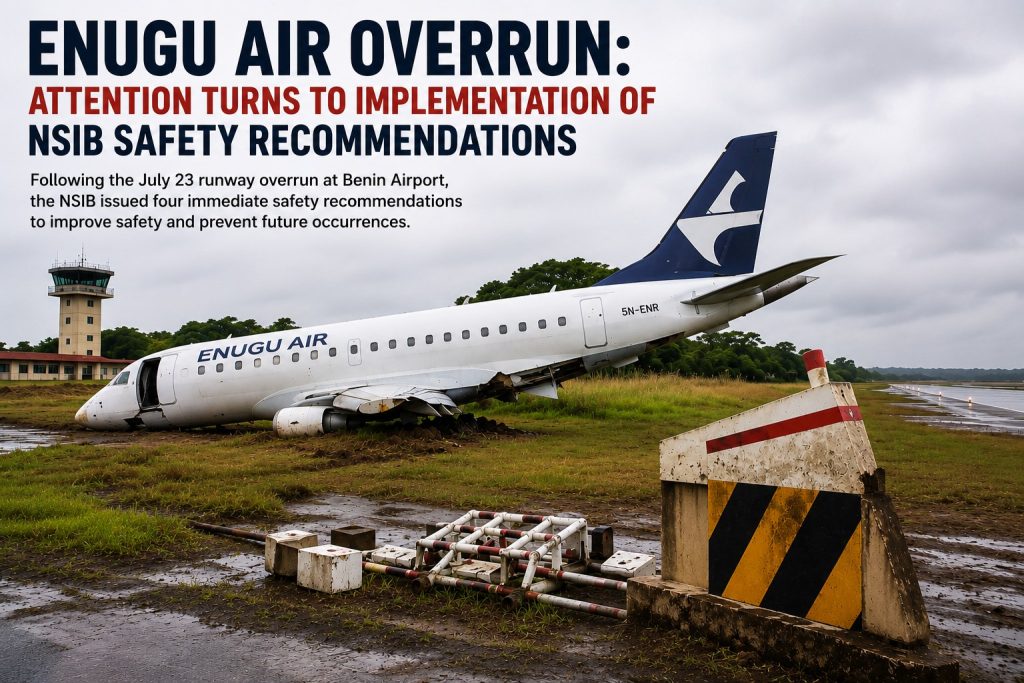
Attention is shifting to the implementation of safety recommendations issued by the Nigerian Safety Investigation Bureau following last month’s Enugu Air runway overrun at the Oba Akenzua II Airport in Benin, Edo State.
The NSIB, in its preliminary report released on August 21, issued four immediate safety recommendations to the Nigerian Civil Aviation Authority, Federal Airports Authority of Nigeria and Nigerian Meteorological Agency over concerns identified during its ongoing investigation.
The recommendations raise wider questions about the runway-end environment at the airport, visibility from the control tower and the availability of meteorological information required to support safe flight operations.
The accident occurred on July 23, 2026, when an Enugu Air Embraer ERJ 170-100LR aircraft, registration 5N-ENR, operating Flight ENU4264 from Lagos to Benin, overran Runway 05 after landing.
There were 63 passengers and five crew members on board. All 68 occupants were evacuated without injury, although the aircraft sustained substantial damage after leaving the runway and striking approach-lighting installations and two fixed concrete structures associated with a decommissioned localiser installation.
Four Safety Recommendations
One of the immediate recommendations requires the NCAA to ensure that FAAN removes the fixed structures associated with the decommissioned localiser installation located beyond the end of Runway 05.
NSIB also recommended that the NCAA ensure the control tower at the airport is positioned to provide an unrestricted view of all movement areas.
FAAN was separately asked to provide the Nigerian Airspace Management Agency with a suitable control tower location offering an unrestricted view of the aerodrome, while NiMet was directed to restore and maintain the serviceability of weather-information display equipment provided for operational use in the Benin control tower.
These recommendations go beyond the immediate circumstances of the aircraft’s landing and draw attention to airport infrastructure and the availability of operational information to air traffic personnel.
What the Preliminary Investigation Found
According to information contained in the preliminary investigation, the aircraft approached Benin amid deteriorating weather conditions, including rain and reduced visibility.
The flight crew had also indicated during the approach briefing that the aircraft’s autobrake system was inoperative and that manual braking would be used for landing.
The aircraft eventually touched down about 1,641 metres beyond the Runway 05 threshold at a groundspeed of approximately 138 knots. Investigators also identified a tailwind component during the approach and touchdown.
NSIB’s investigation further found that no Runway Condition Report or Runway Condition Code was transmitted to the flight crew, while an unfinished structure obstructed the Benin control tower’s direct view towards part of the aerodrome.
The findings have made implementation of the bureau’s immediate recommendations an important part of the safety response to the accident.
Investigation Not Yet Concluded
NSIB has, however, cautioned that the preliminary findings do not constitute a final determination of the cause of the accident.
The bureau said further work would examine runway conditions and reporting procedures, meteorological information, the aircraft wreckage and landing-gear separation, the impact sequence, crew training and experience, operational decision-making and relevant Enugu Air procedures.
The final investigation report is expected to contain the bureau’s conclusions and any additional safety recommendations considered necessary.
For now, the four immediate recommendations provide specific areas for aviation authorities and agencies to address while the technical investigation continues.
As of the time of this report, CeewhyNews had not identified a subsequent public statement from the affected agencies confirming completion of all four measures.
The next significant development will therefore be whether the relevant authorities implement the recommended corrective actions and what additional findings emerge when NSIB concludes its investigation.