
NSIB Report Finds Safety Gaps After Enugu Air Runway Overrun
By Cynthia Okere, Lagos
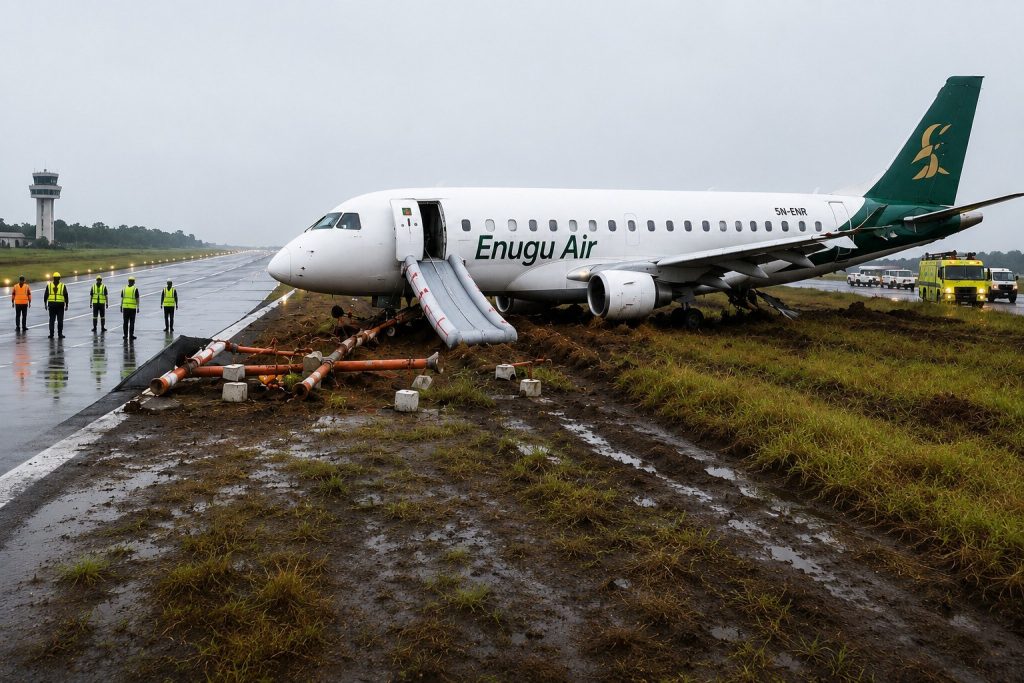
The Nigerian Safety Investigation Bureau (NSIB) has identified a number of operational and airport safety concerns following the runway overrun involving an Enugu Air aircraft at the Oba Akenzua II Airport in Benin, Edo State.
The findings are contained in the Bureau’s preliminary report on the July 23, 2026 accident involving an Embraer ERJ 170-100LR aircraft, registration 5N-ENR, operated by Enugu Air Limited.
The aircraft was operating scheduled passenger flight ENU4264 from Murtala Muhammed International Airport, Lagos, to Benin when it landed on Runway 05 and subsequently overran the end of the runway into an unpaved area.
There were 63 passengers and five crew members on board. All 68 occupants were evacuated without injury through the aircraft’s emergency escape slide. The aircraft, however, struck approach-lighting installations and two fixed concrete structures associated with a decommissioned localiser installation after leaving the runway.
Landing conditions under investigation
Details from the preliminary investigation indicate that the aircraft landed under challenging conditions, including rain, a wet runway, reduced visibility and tailwind.
The crew had also established during the approach briefing that the aircraft’s autobrake system was unavailable and that manual braking would be used for the landing.
Flight recorder information cited in reports on the NSIB findings showed a tailwind of about 12 knots at the runway threshold and 6.4 knots at touchdown. The aircraft touched down approximately 1,641.5 metres from the threshold of the 2,400-metre Runway 05, leaving about 758.5 metres of runway remaining.
NSIB said its continuing investigation would further examine the circumstances surrounding the flight, including crew decision-making and applicable operational procedures.
Safety concerns at Benin Airport
Beyond the operation of the aircraft, the investigation raised concerns about airport infrastructure and the availability of safety information.
The Bureau identified issues involving the runway-end environment, visibility from the airport control tower and the availability of meteorological information.
Following the findings, NSIB issued four immediate safety recommendations, numbered A-2026-039 to A-2026-042, to the Nigerian Civil Aviation Authority (NCAA), Federal Airports Authority of Nigeria (FAAN) and Nigerian Meteorological Agency (NiMet).
The recommendations are aimed at addressing the identified concerns surrounding the runway-end environment, control tower line of sight and availability of weather information to support flight operations.
Investigation not yet concluded
NSIB stressed that the report is preliminary and does not represent the final conclusions on the cause of the accident.
According to the Bureau, information gathered so far includes witness statements, flight recorder data, air traffic control communications and preliminary inspection of the aircraft, while further technical examinations are continuing.
The Bureau said the final investigation report would contain its conclusions and any additional safety recommendations arising from the investigation.
Under international aviation investigation standards, the purpose of an NSIB investigation is to establish the circumstances surrounding an occurrence and make recommendations to prevent a recurrence rather than assign blame or liability.