
IGH Hackathon Develops VR Tools for Genomics, African Healthcare
By Cynthia Okere, Lagos
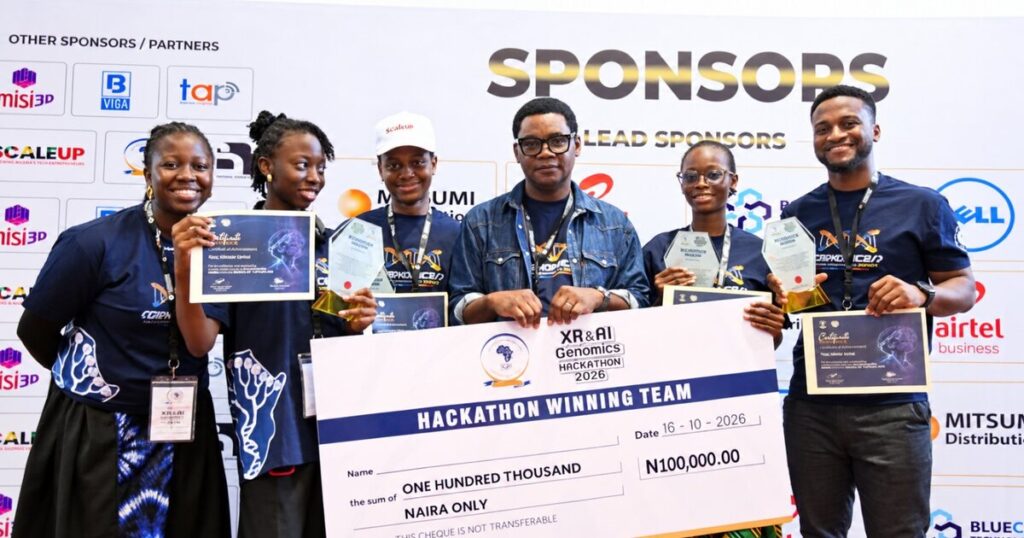
The Institute of Genomics and Global Health, IGH, at Redeemer’s University has concluded its 2026 XR and Artificial Intelligence Genomics Hackathon, with participants developing virtual reality prototypes for teaching polymerase chain reaction procedures.
The programme, held under the theme, “From Genome to Impact: XR and AI Solutions for African Health,” brought together scientists, software developers, 3D artists and science communicators to explore how emerging technologies could improve genomics education and healthcare delivery in Africa.
The hackathon ran from September 28 to October 16, 2026, and ended with a Demo Day at the IGH/ACEGID Auditorium, Redeemer’s University, Osun State, Western Nigeria.
More than 196 people registered for the programme, which featured workshops, mentorship, project development, presentations and an awards ceremony.
Participants worked in five teams, with each group assigned a stage of the polymerase chain reaction, PCR, process. PCR is a laboratory technique used to produce multiple copies of a selected DNA segment for analysis.
The prototypes covered the history and principles of PCR, equipment and reagents, master mix preparation, PCR plate setup, and the loading and operation of a virtual PCR machine.
Team 5, which developed the “Load and Run” stage, emerged as the overall winner. Teams 2 and 3 placed second and third respectively, while Teams 4 and 1 finished fourth and fifth.
The results were announced by the lead judge and Provost of the Postgraduate School at Redeemer’s University, Professor Adeleke Osho, alongside Professor Adewale Ogunde of the Department of Computer Science.
The projects will contribute to GenomicsXR, an extended-reality platform being developed by IGH to make laboratory procedures easier for learners to visualise and understand.
Its first module, which focused on DNA extraction, was deployed in 2025. IGH plans to review and integrate the five PCR prototypes into a single interactive learning experience.

Speaking at the event, Nigerian management consultant, Mr Emeka Odibeli, challenged young innovators to use artificial intelligence and immersive technologies to solve practical African problems.
Odibeli, who spoke on Nigeria’s innovation drive and the future of work, said AI could help people work faster and develop more effective responses to social and economic challenges.
He said the relevance of any technological solution should be measured by its capacity to address real needs within its immediate environment.
“If it cannot solve a problem locally, it will not be useful globally,” he said.
Odibeli advised participants not to concentrate solely on developing impressive demonstrations but to build tools that could improve healthcare delivery.
“Do not just build a genome analyser; build a tool that can help hospitals. In extended reality, do not just build a VR demonstration; build a surgical training simulator that can reduce the cost of training medical students,” he said.
He noted that innovators could also develop technology-based solutions to help people affected by common diseases such as malaria access better information and healthcare services.
According to him, the existence of similar products should not discourage innovators, as a clear sense of purpose and attention to local realities could distinguish one solution from another.
Odibeli also described properly annotated genomic data on African populations as highly valuable, stressing that innovators must understand how to use such data responsibly to solve local health problems.
“Your data is more valuable than your algorithm. While conducting research, always bring it back home and compare it with local data,” he said.
He added that investors were interested in innovators capable of using AI to address clearly defined problems rather than merely developing technology without practical application.
The Director of IGH, Professor Christian Happi, emphasised the importance of building genomics research capacity, while the institute’s Deputy Director, Professor Folarin Onikepe, highlighted personalised medicine and the need for African genetic diversity to be represented in genomic research.

IGH said the next phase of the project would involve connecting the five PCR stages, refining their interactions, verifying their scientific accuracy and testing the platform with intended users.